
How to Check Criminal History in Watertown
A useful Watertown search starts with the type of event, not just a name. The Watertown Police Department public-records channel is the source for a city incident report, officer narrative, or available recording. Watertown Municipal Court handles the city's noncriminal ordinance citations. A felony, misdemeanor, or criminal-traffic filing appears through the circuit court for the county where the incident occurred. Wisconsin Circuit Court Access, also called WCCA or CCAP, can then reveal the public docket. Wisconsin DOJ's WORCS product answers a different question by returning a name-based, fingerprint-supported statewide criminal-history response.
Use a Watertown report number or citation number when one is known. Names alone can match more than one person. Watertown dates, the event address, birth information, and case chronology help separate records. Follow this order:
- Ask Watertown Police for the incident or arrest report and provide details that identify the event.
- Contact Watertown Municipal Court when the matter is a city ordinance or nonparking traffic citation.
- Confirm whether the incident site was in Jefferson County or Dodge County before looking for custody or prosecution.
- Search WCCA in the correct county for a filed CF, CM, or CT circuit case.
- Use Wisconsin DOJ WORCS when a statewide, fingerprint-supported history is the record needed.
Watertown Criminal Records Cross Counties
Watertown spans Jefferson and Dodge Counties. That Watertown fact can trip up even a careful searcher. A Watertown population figure covers both sides, but a jail booking or circuit case does not follow the city total. The Watertown incident location controls which county agencies receive the person and later court referral. Watertown Police still holds its own originating report, regardless of which county handles the next stage.
The 2020 Census place data counted 22,926 residents in the whole incorporated city. That source is useful because it shows why city identity and county jurisdiction are separate facts.
For record routing, ask where the stop, call, or alleged conduct took place. Then use Jefferson County or Dodge County custody and court systems as appropriate. City name alone is not enough.
The Watertown Police Department
Watertown Police Department operates at 106 Jones Street, Watertown, WI 53094. Records Clerk Becky Wegner can be reached at 920-206-4219, while the police nonemergency line is 920-261-6660. The records counter is open from 8:00 a.m. to 4:00 p.m. The department accepts requests by email at pdrecords@watertownwi.gov, by phone, at the counter, by mail, and by fax at 920-262-9710. Driver information may require the linked DPPA permissible-use or release form.
The official Watertown Police Department profile identifies the city office and its services.
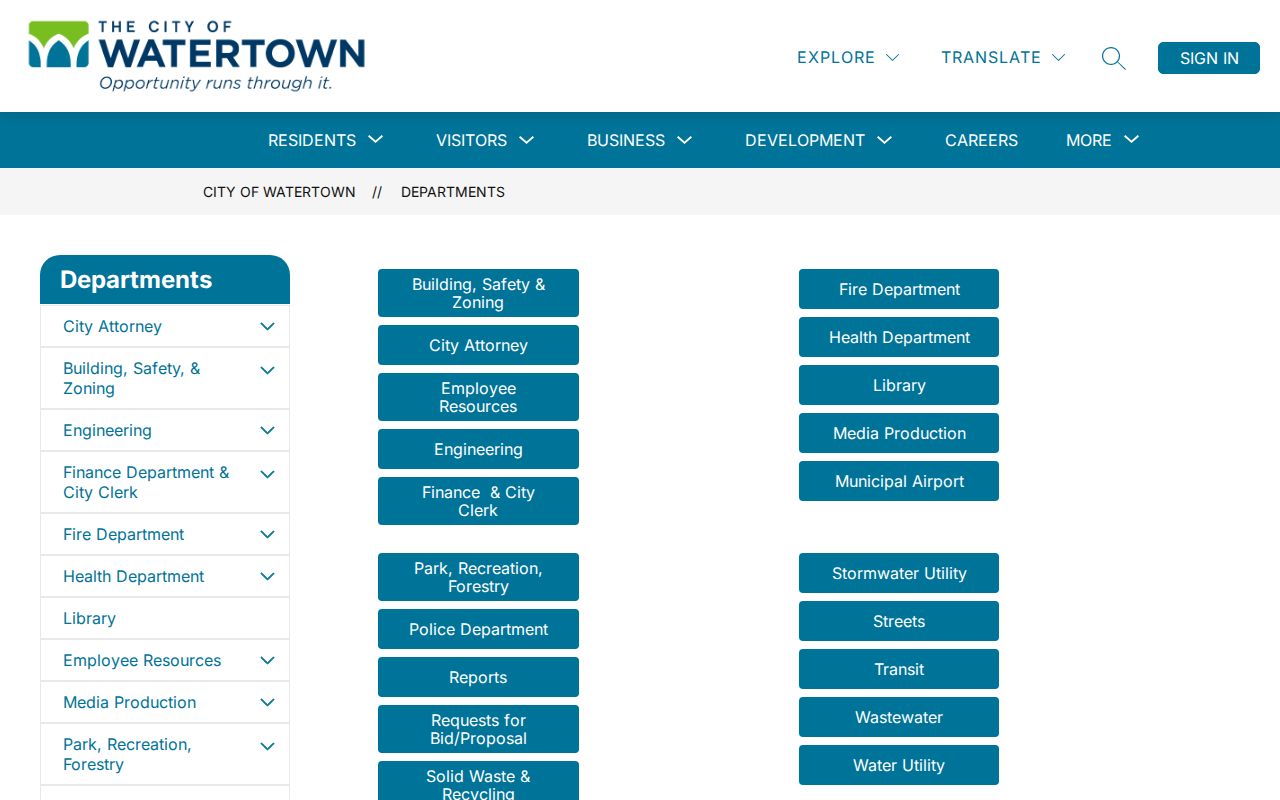
Watertown has no public name-based arrest portal. Direct contact is therefore the key Watertown route. Ask for a defined Watertown police report, photo, dispatch audio, or video rather than a broad request for everything about a person.
Watertown Police Records
106 Jones Street
Watertown, WI 53094
920-206-4219
pdrecords@watertownwi.gov
8:00 a.m.-4:00 p.m.
Build a Watertown Records Request
Watertown accepts free-form requests rather than forcing every Watertown request through one general web form. Specific details help Watertown staff locate the right record and support the city's stated goal of responding within 10 business days. Include the incident date and place, names and dates of birth of known parties, the incident type, and the Watertown police report number if available. Add the requester's name, mailing address, and phone number for billing or follow-up.
The Watertown city directory gives the department's staff and contact path.
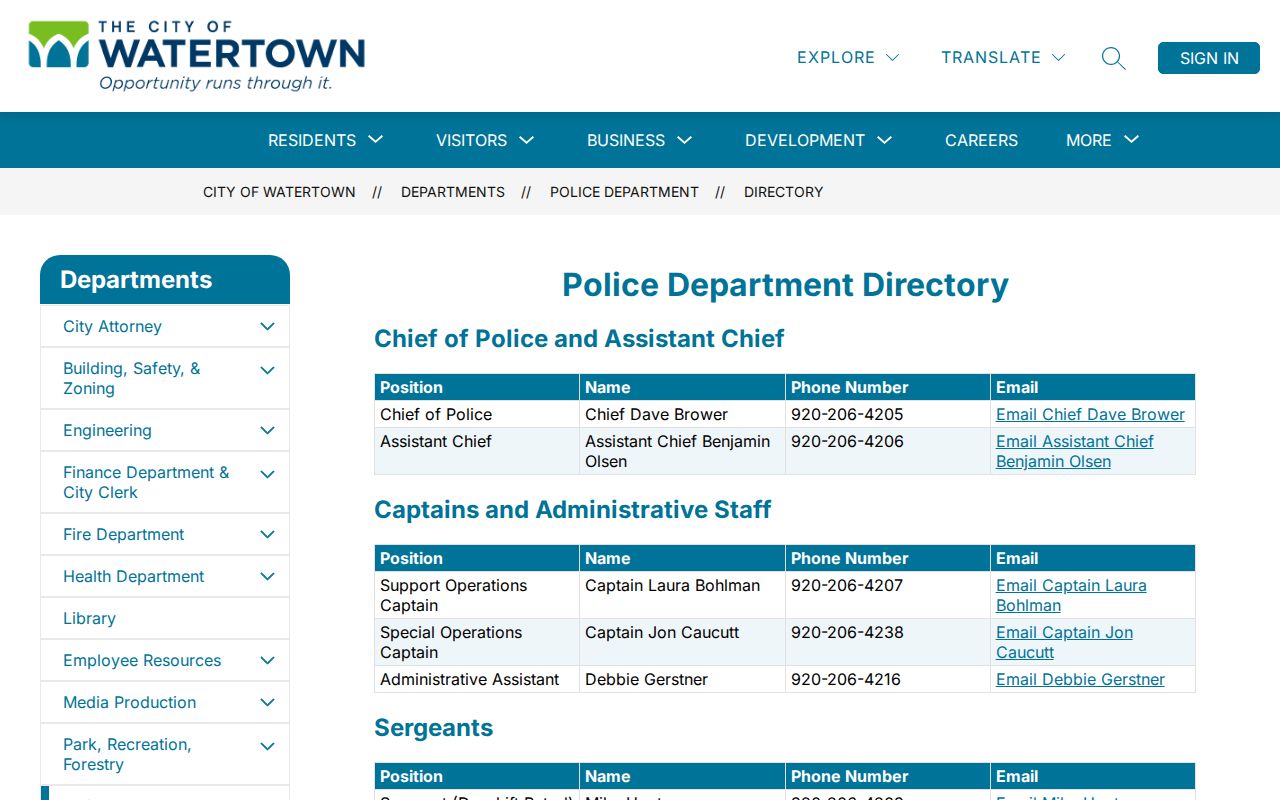
A narrow request can also reduce redaction and review time. For a crash, the city points readers to Wisconsin DOT as another route. If protected driver data is involved, complete the required DPPA paperwork instead of assuming the full report is open without limits.
Watertown requesters can use email, mail, fax, the records counter, or the records phone line. Each Watertown route reaches the same local custodian, but the medium should fit the item. A written Watertown request is useful when several records or exact date ranges are involved. A phone call can clarify scope before a large audio or video order. The published fax gives another written path, while a counter visit allows the requester to discuss which Watertown report number controls. When another person will receive protected driver data, the conditional DPPA release paperwork may also be needed.
Arrests and Bookings in Watertown
Watertown does not advertise a city jail or online inmate roster. Watertown Police creates the incident and arrest report, then custody shifts to the county that has jurisdiction. On the Jefferson County side, the county jail creates the Watertown booking file, fingerprints, photograph, property record, bond paperwork, and custody log. The jail's protected medical and security screening is not the same as a public Watertown booking record.
A recent Watertown arrest may not yet have a court case. Start with the police report, verify the county, then check the relevant jail. Search WCCA after prosecutors file a public case. Wisconsin DOJ's repository may receive qualifying fingerprints and later outcomes, but it is not a copy of the city report. More county-level routes are available in the Jefferson County arrest history resource.
Record flow: Watertown Police › correct county jail › circuit court › Wisconsin DOJ Crime Information Bureau.
Watertown Police Record Prices
Watertown publishes separate charges for paper and audiovisual products. A black-and-white Watertown case report costs $0.25 per page. A Watertown 911 telephone recording, radio communication, Intelligent Video Recording, or squad or body-worn-camera record costs $20 per incident. USB media and shipping use standard rates, though the Watertown page does not state a single amount for each. Confirm the total before payment when a request spans more than one incident.
| Watertown record | Posted charge |
|---|---|
| Black-and-white case report | $0.25 per page |
| 911 telephone recording | $20 per incident |
| Radio communication | $20 per incident |
| Intelligent Video Recording | $20 per incident |
| Squad or body-camera file | $20 per incident |
Watertown fees describe the copy product, not a promise of release. The Watertown custodian may still redact protected content or withhold material under a specific law or the Wisconsin balancing test.
Watertown Municipal Court Records
Watertown Municipal Court sits at 106 Jones Street, Room 2065. Judge Mark S. Sweet and Court Clerk Debbie Schuett are listed on the official page. The clerk can be reached at 920-206-4203 or by fax at 920-206-4225. Hours are 8:00 a.m. to 4:00 p.m. Monday through Thursday and 8:00 a.m. to noon Friday. There is no public name or citation search on the official site, so status and copy questions go to the clerk.
The Watertown Municipal Court page identifies its Watertown citation process and contact channels.
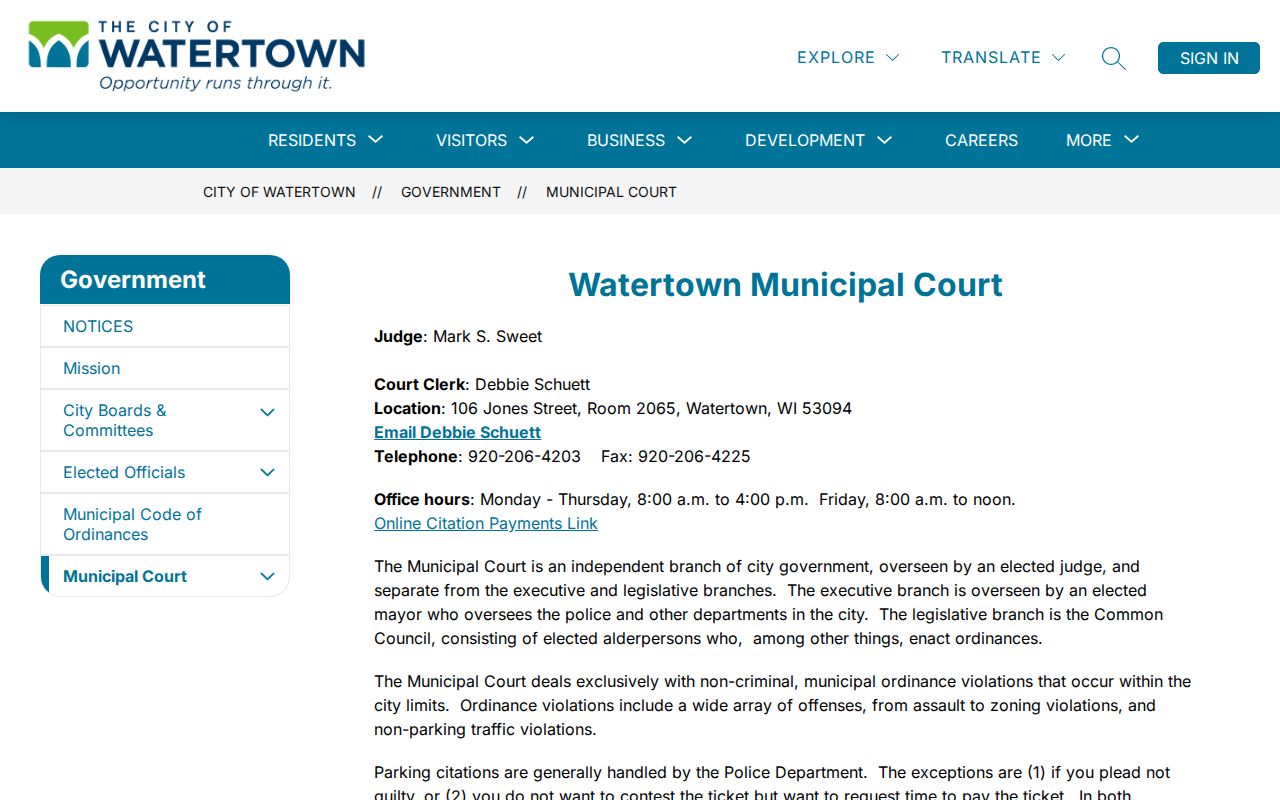
Most important, Watertown Municipal Court handles noncriminal municipal ordinance violations. The Watertown court does not hold the felony or misdemeanor case file. Those cases belong in circuit court.
| Court Name | Watertown Municipal Court |
|---|---|
| Case Types Heard | Noncriminal municipal ordinances and nonparking traffic matters |
| Case Lookup Channel | Clerk by phone, mail, fax, email, or counter; no public case search found |
| What the Docket Shows | Citation, plea, appearance, disposition, payment, and related court activity |
| Copies & Fees | Ask the clerk; no copy or search fee is posted |
Watertown Citation Records and Appearances
A Watertown citation gives an initial appearance date, but the city permits a person to appear at either 10:30 a.m. or 5:30 p.m. on that date. The time printed on the citation does not remove that choice. Correspondence should include the ticket number, name, and address so court staff can match it to the right municipal record.
Parking citations usually remain with Watertown Police. Municipal Court becomes involved if a person pleads not guilty or asks for time to pay. That division matters when seeking a record: police may hold the parking citation, while the clerk holds the resulting court activity. Online citation payment is available, but a payment screen is not a public record lookup.
Note: A municipal forfeiture is a noncriminal money consequence, not a felony or misdemeanor conviction.
Where Watertown Records End Up
Each Watertown custodian keeps a different layer. Watertown Police maintains calls, incident reports, arrest narratives, and available recordings. Watertown Municipal Court maintains noncriminal ordinance and traffic citation activity. The proper county circuit clerk keeps filed Watertown criminal cases. Wisconsin DOJ CIB assembles a fingerprint-supported statewide history from qualifying law-enforcement, prosecutor, court, and corrections reports.
Record flow: Watertown Police › Jefferson or Dodge County Courts › Wisconsin Department of Justice, Crime Information Bureau.
Recent events are most likely to be clear at the originating office. WCCA is best for the filed public docket. WORCS is a point-in-time name check, not a certified identity match and not the city report. Compare birth data, charges, county, and dates before concluding two records concern the same person.
Watertown Body-Camera Criminal Records
Watertown's body-camera policy treats the equipment and its data as police property. Officers with cameras activate them for calls for service and face-to-face official contacts, subject to stated exceptions. They also note recordings in the written report. A recording linked to a generated case number enters the evidence chain, which helps a requester identify it by report number.
The official Watertown body-camera policy sets a minimum retention period of 120 days.
Some files remain longer because of a criminal case, internal investigation, open-records request, or another retention rule. The practical lesson is simple: identify and request the recording promptly, with the event date, site, and report number when known.
Watertown officers note a recording in the related report, so that written record can help locate the video. If a Watertown case number was generated, the recording follows the evidence chain instead of the ordinary minimum-retention path. An open-records request can also affect how long responsive footage must be preserved. Still, retention does not guarantee public release of every frame or sound. Watertown staff may need to remove protected victim, juvenile, medical, or private information before producing a copy.
Watertown Premise Alert Records
Watertown says its Police Department was the first Wisconsin police agency to start a Premise Alert System. A mother of an autistic child brought the idea forward in 2008. The program lets residents voluntarily share information that can help responders at a home or other premise. Participation is free, information may be withdrawn, and the department contacts participants each year to verify or update it.
The city's Premise Alert System history shows how a local safety program can create a police-held record without being an arrest file.
Do not confuse a voluntary alert with a criminal-history entry. It serves response planning, not public accusation. Access to personal or safety-sensitive content may be restricted even though the program itself is public.
Public Access Rules
Watertown Police and Municipal Court are subject to Wisconsin Public Records Law. The law starts with a presumption of inspection and copying, then applies statutory limits and a public-interest balancing test. A custodian may redact private identifiers, victim or juvenile information, protected driver data, or active investigative details. Court rules can also keep juvenile, confidential, expunged, or sealed matters outside public view.
Key Statutes:
Wis. Stat. § 19.35 gives the public a right to inspect or copy authority records, subject to lawful limits.
Wis. Stat. § 165.83 governs qualifying criminal-history collection and reporting to Wisconsin DOJ.
Wis. Stat. § 59.40 assigns circuit-court recordkeeping duties to the clerk.
Ask the Watertown custodian for the reason if material is withheld. A released Watertown police report may differ from the public WCCA docket because the two offices hold different records. For a broader explanation of the county and state layers beyond Watertown, see the Jefferson County criminal history overview.